The regulators’ first joint publication on the 2029 price review puts forward-looking evidence about asset condition at the centre of the next investment cycle. Aqualogic InSight is built to produce exactly that. Every fitting checked. Every check recorded.
On 3 November the Drinking Water Inspectorate, the Environment Agency, Natural England, Natural Resources Wales and Ofwat published Working together to deliver PR29, subtitled A collaborative, transparent and company-specific price review for water. It is the first joint publication from the regulators shaping price review 2029, the review that will set the price controls taking effect in 2030.
It came with a joint letter to industry leaders, in which the five regulators commit to coordinating their decisions and communications, engaging jointly and integrating their approaches through the transition to new regulatory arrangements. PR29, they say, will build on PR24 but look and feel different from previous price reviews.
Much of the document is about how those regulators intend to work with each other and with the sector, and it is written during a period of structural change. The UK Government has confirmed its intention to create a single integrated water regulator for England, bringing together relevant functions from Ofwat, the Environment Agency, the Drinking Water Inspectorate and Natural England. The Welsh Government has signalled plans for a dedicated economic regulator for Wales, intended to be in place after PR29. PR29 will be developed by the current regulators through that transition, with Ofwat still responsible for publishing the methodology.
Evidence is doing more of the work
Underneath the governance, one theme runs through the document, and it has practical consequences for anyone working on leakage and demand management.
Under the heading long-term outcomes and value for money, the regulators say they will consider how forward-looking evidence can provide greater transparency about asset condition, future risks and the maintenance and replacement activity needed to secure long-term resilience. The same section commits to a continued focus on maintaining and improving asset health, and to improved stewardship of assets and natural capital.
That is a request for a record of network condition, not simply a count of what was found and fixed.
It is reinforced several times over. Companies will need to show that proposed expenditure is necessary, deliverable and represents best value, explaining the main cost drivers, the alternatives considered and the implications for outcomes, risks and customer bills over time. Plans will need to reflect local, regional and catchment evidence, and companies should be able to show how that evidence informed both the development and the appraisal of their proposals. Regulators will take greater account of company-specific circumstances, including performance, asset management and delivery capability, alongside the benchmarking and comparative assessment that remain in place. The Common Options Appraisal and Assurance Framework is to be applied across relevant planning processes, giving a consistent basis for considering costs, benefits, risks, natural capital, deliverability and long-term value.
The conversation starts earlier, too. The document asks companies to engage openly from the outset, sharing evidence and emerging thinking rather than presenting fully developed proposals late in the process. Evidence is expected on the table while options are still open.
The gap it lands against
The National Audit Office found that water mains were replaced at 0.14% a year across the first four years of PR19. PR24 added £456m to renew 8,445km of mains by 2030. Deciding which kilometres, and defending that decision when it is examined later, depends on knowing the condition of what is already in the ground.
What that asks of a survey
Most leak detection is built to find leaks. It is measured on the leaks it finds, and what it leaves behind is a list of jobs. A technician spends most of the day not finding a leak, and at present that time produces nothing a company can show anyone. It answers the question a leakage target asks. It does not answer the questions PR29 will ask: what condition is this network in, what was inspected to reach that view, and how did that evidence shape the investment being proposed.
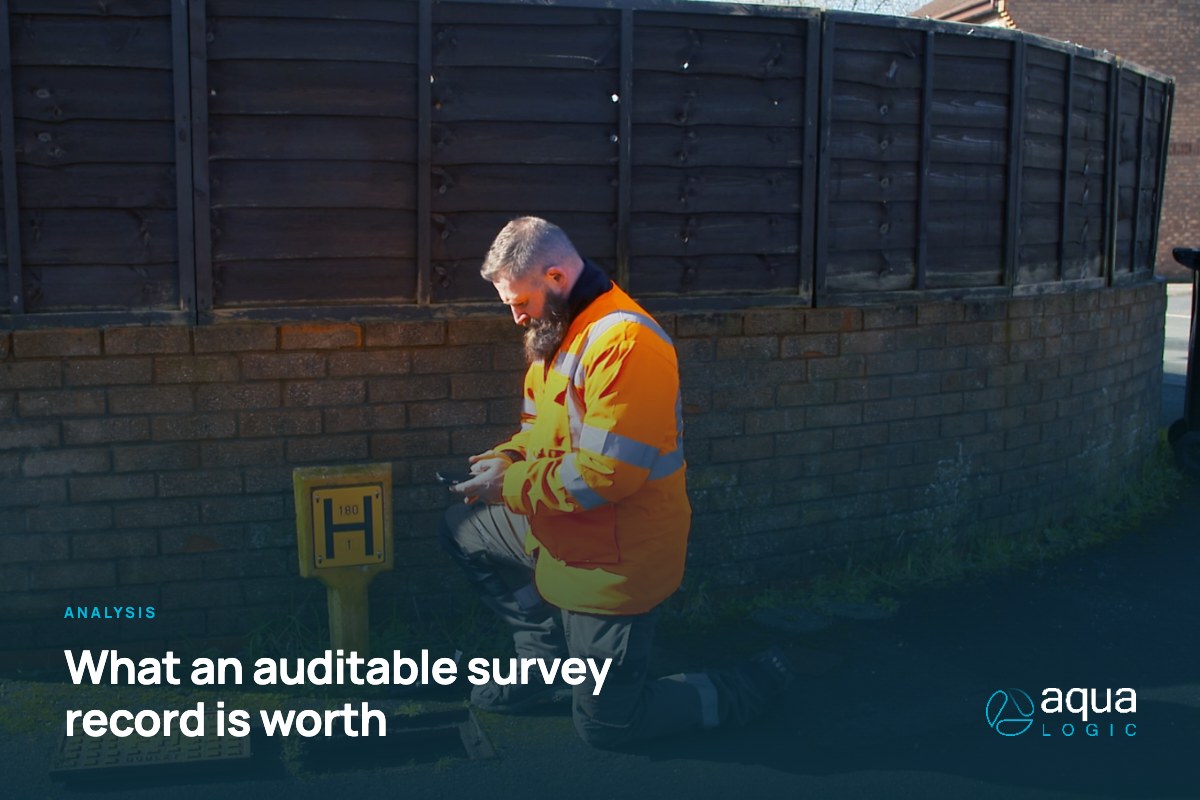
Aqualogic InSight is built the other way round. An acoustic sample is recorded at every fitting on the route, tied to its location and the time it was taken and quality graded, whether or not a leak is present. The fittings that are not leaking carry most of the asset information, and they are the large majority of any survey. We set out how that record is built in what an auditable survey record is worth.
It is worth being precise about what that does and does not establish. Survey evidence describes the scope and the conditions inspected. It does not guarantee the absence of leaks, and it does not establish the structural condition of every asset. What it does establish is what was checked, when, what was observed and what remains unresolved, which is more than most leakage reporting can currently show.
Coverage can be evidenced as well as claimed. Overlaying survey datasets across the same area shows where the survey reached and where it did not, so a company can demonstrate what was inspected rather than assert it. Most leakage reporting can say what was found. Far less of it can say what was looked at.
What a record answers that a leak count cannot
- 01It describes what was observed, not just what failedThe regulators want forward-looking evidence about asset condition, future risks and the maintenance and replacement activity needed. A leak list describes faults at a moment in time. A survey record describes what was observed across the assets inspected, including the ones that were sound.
- 02It shows what was inspectedCompanies will have to explain how local and regional evidence informed both the development and the appraisal of their proposals. That explanation is weaker if nobody can say what the survey actually covered, or where it did not reach.
- 03It gives something to appraise againstExpenditure has to be shown to be necessary, deliverable and best value, with the alternatives considered set out alongside it. A dated record is something to test an option against, and to return to when a determination is being argued two or three years later.
- 04It compoundsRepeat passes over the same district turn single surveys into a history of how that network is changing, which is what a 10 and 25 year investment pathway needs underneath it.
Why it works better connected than separated
PR29 assesses long-term planning, local evidence, customer priorities, asset management and delivery capability together rather than in isolation. Network survey, customer-side work and field delivery each answer part of that picture on their own. Run as one connected operation, they produce a single evidence chain, from what the network data shows, through what was found on the ground, to the work carried out and recorded against it. That chain is far harder to assemble after the fact from three separate suppliers.
The same visit also records more than leakage. Customer fitting condition and access, network fitting condition, unregistered connections, the household and non-household split, failure hotspots and recurring defects: that evidence is worth something to asset planning, water quality and compliance, water resources and capital maintenance, as well as to the leakage team that commissioned it. One visit can pay back into eight parts of the business. Seven of them are not leakage.
Deliverability is part of the test too. The regulators say they will assess the readiness and deliverability of company proposals as well as companies’ capacity to deliver them. A method is only useful at the scale a programme needs, which makes the ability to train and mobilise field teams part of the evidence rather than a detail of procurement.
The window is now, not 2028
None of this is a new argument for the people running leakage operations. What has changed is that the regulators are now asking for it in writing.
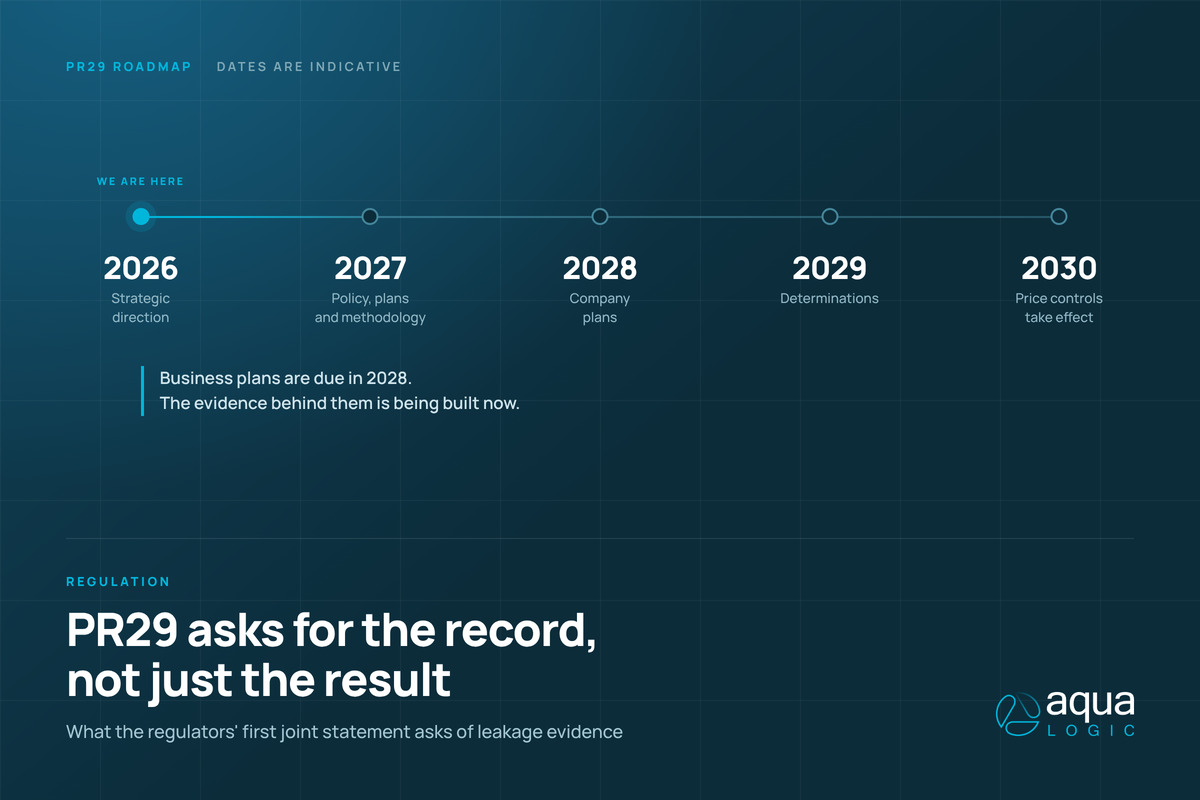
The timetable gives it shape, although the regulators describe their dates as indicative. Policy and plan development runs from January to August 2027. The methodology is consulted on and finalised between September and December 2027. Companies submit business plans in 2028, assessment and determinations follow in 2029, and the price controls take effect in 2030. The evidence base those plans rest on is being built now.
Sources: Working together to deliver PR29, Drinking Water Inspectorate, Environment Agency, Natural England, Natural Resources Wales and Ofwat, 3 November 2026. Regulating for investment and outcomes in the water sector, National Audit Office, HC 853, 25 April 2025. Mains renewal funding: Ofwat, PR24.
Aqualogic InSight
See what one visit would record on your network.
The InSight page carries a sample evidence record, including the acoustic samples, the frequency analysis and the DMA health check behind them, so you can see the level of evidence a survey produces before commissioning one. Tell us about your network and the questions you need answered, and we will come back to you with what InSight would record and who inside your business it would be worth something to.