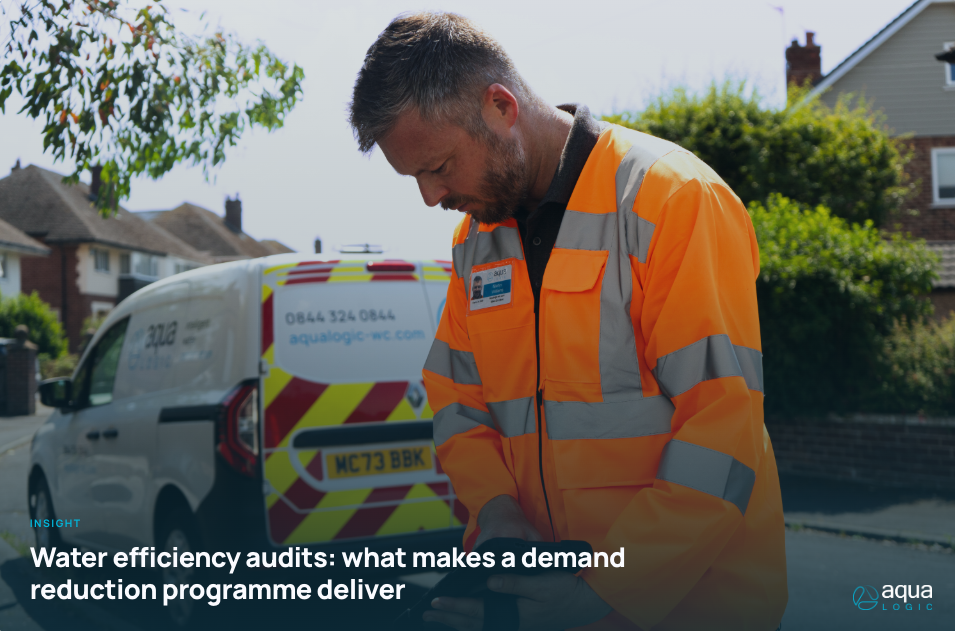
Water efficiency audits: what makes a demand reduction programme deliver
Of the demand commitments set at PR24, per capita consumption is the awkward one.
Leakage sits on assets the company owns. It can be found, fixed and counted. Per capita consumption sits inside properties the company does not control, depends on the behaviour of people it cannot instruct, and is measured against a baseline that moves with the weather and with how many people are at home during the day. That argument was put to Ofwat during the PR24 consultation, on the basis that consumption is materially affected by factors outside company influence. Ofwat set three separate demand commitments anyway, for leakage, per capita consumption and business demand, and put a £100 million water efficiency fund behind the effort.
Water efficiency audits are the only intervention in the whole demand programme that crosses the property boundary. That makes them the point where the commitment is either delivered or quietly missed. What follows is what we have learned about which of those happens, from running these programmes for UK water companies since 2007.
Fixed savings and behavioural savings are not the same asset
Every audit produces two kinds of saving, and treating them as one number is the most common reason a programme looks strong at year one and thin at year three.
Fixed savings come from something physically installed: a flow regulator, an aerator, a cistern device, a urinal control. Once fitted, the saving persists whether or not anyone remembers the visit. It decays only when the fitting is replaced or removed.
Behavioural savings come from the conversation. They are real, they can be substantial, and they decay. How fast depends on how well the advice fitted the household in the first place, which is why a specialist who listens produces a more durable number than one working through a checklist.
A programme reported as a single litres-per-property figure hides that split entirely. A programme that reports the two separately gives the company something it can forecast against, and gives the regulator something that stands up to scrutiny. It also changes procurement, because the cheapest cost per visit is rarely the cheapest cost per litre still saved in five years.
The targeting problem, and what smart metering changes
Historically, demand programmes visited whoever answered the door. Uptake was the metric, because uptake was the only thing that could be measured cleanly.
That is changing. Ofwat has allowed over £1.7 billion for the installation of 10.4 million smart meters between 2025 and 2030, and the consumption data those meters produce makes targeting possible for the first time at scale. Continuous flow at a property is one of the clearest indicators available that something is running which should not be. High and rising consumption against a stable occupancy profile is another.
The implication is that the audit stops being a broadcast activity and becomes a targeted one. Visit the properties the data has flagged and the yield per visit rises sharply, because those properties have something wrong with them rather than merely a willingness to open the door.
That only works if three things line up: the metering data, the field capability to act on it, and the analysis in between. Companies that hold those in three separate contracts tend to find the handovers cost more than the leak did. It is why our Intelligence, Saving Water and network teams are built to work off the same information rather than in sequence.
What water efficiency audits actually find
The largest savings sit in the least interesting places, which is fortunate, because the least interesting places are the easiest to change.
Toilets come first, and the numbers are worth stating plainly. Waterwise puts the proportion of UK toilets leaking at any one time at 5 to 8%, wasting between 215 and 400 litres of treated water per toilet per day. Nationally that is an estimated 400 million litres a day leaking from UK toilets, enough to supply around 2.8 million people. Set the per-toilet figure against average consumption of around 146 litres per person per day on Ofwat’s numbers, and a single faulty flush valve can outweigh every other saving in the property.
The reason it persists is that it is invisible. There is no puddle and no noise, just water moving silently from the cistern into the bowl. Water UK found that 61% of people assume a faulty flush wastes less than 50 litres a day, which is under a quarter of the real figure at best. That perception gap is the strongest single argument for sending somebody to look, because no customer communication campaign will surface a problem the customer does not believe exists.
After that the pattern is consistent: showers running well above the flow rate anyone notices, outside taps and irrigation running longer than intended, and in mixed-use properties, urinals flushing through the night to an empty building.
Verification is about to matter more than it does now
The water white paper published in January signalled a move away from companies inspecting and reporting on their own performance, towards independent oversight, asset health metrics and more open data. Whatever the final shape of the new regulator, the direction is clear enough to plan around.
For demand programmes that means the evidence trail behind a reported saving will be examined more closely than it has been. Which properties were visited, what was found, what was fitted, what was measured afterwards, and what the company is claiming as a result.
This is a supply chain question as much as a company one. If a delivery partner cannot produce a per-property record of what was installed and why, the gap becomes the company’s problem at the point somebody asks. It is why our field data workflows carry photo evidence and a full audit trail as standard, the same discipline we apply on our smart metering programme work.
What to look for in a delivery partner
Four questions separate programmes that hold their numbers from programmes that report them.
- Can they split fixed and behavioural savings in their reporting, or do they hand back one blended figure?
- Can they act on consumption data to target visits, or do they need a list handed to them?
- Is the product range they fit compliant and specified, or assembled from whatever is available? Ours are Reg 4 compliant (utilising WRAS approval), and we have been designing and sourcing water saving products since the first tap flow restrictor in 1979.
- Can they produce the per-property evidence trail on request, months later, without a special exercise?
They are the difference between a programme that survives a regulatory conversation and one that does not.
The wider arithmetic
Water companies expect England and Wales to need upwards of an extra 4 billion litres of water a day by 2050, around a quarter of what currently goes into supply, and Ofwat expects at least half of that to come from water efficiency and leakage reduction rather than from new supply. The government ambition is 110 litres per person per day against around 146 today, and the national Let’s Save Water campaign is the public-facing side of the same effort.
Neither half of that arithmetic works alone. Reported leakage already includes supply pipe losses on customers’ own pipes, so the boundary between network work and customer-side work is thinner than the organisational chart suggests. Companies that treat them as one problem will find the last few percentage points easier to reach than companies that do not.
Working with us
Our Saving Water team has delivered water efficiency programmes for UK water companies since 2007, from two national operational centres, saving around 100 million litres a year across our programmes. We work alongside our network and intelligence teams rather than separately from them, which is the point.
If per capita consumption is a commitment you are carrying into the back half of AMP8, talk to the Saving Water team.

Common questions
What is a water efficiency audit?
A water efficiency audit is a site or property visit that establishes where water is being used, identifies waste, and fits or recommends the changes that will reduce consumption. It covers fittings, appliances, controls and usage patterns, and normally produces both a physical intervention and a set of recommendations.
What is the difference between water efficiency audits and water saving audits?
Nothing meaningful. The two terms are used interchangeably across the sector. Water saving audits is the more common phrase in domestic programmes and water efficiency audits in commercial and regulatory contexts, but they describe the same activity.
Who pays for a water efficiency audit?
For households, audits are usually delivered as part of a water company demand reduction programme, so there is normally no charge to the customer. For non-household sites the position varies, and it is worth asking your retailer or wholesaler what support is available before assuming the cost sits with you.
How much water does a leaking toilet waste?
Between 215 and 400 litres a day, according to Waterwise, which also puts the proportion of UK toilets leaking at any one time at 5 to 8%. Average consumption is around 146 litres per person per day, so a single leaking toilet can exceed the entire daily usage of one person.
Where the figures come from
- Separate PR24 performance commitments for leakage, per capita consumption and business demand. Ofwat, PR24 final determinations: Our approach
- The argument that consumption is affected by factors outside company influence, submitted during the PR24 methodology consultation. Ofwat, PR24 methodology consultation response appendix
- £100 million water efficiency fund. An extra 4 billion litres a day needed by 2050, around a quarter of current supply, at least half expected from water efficiency and leakage reduction. Government ambition of 110 litres per person per day against around 146 today. Ofwat, Water efficiency fund
- Over £1.7 billion allowed for 10.4 million smart meters between 2025 and 2030. Reported leakage includes supply pipe losses on customers’ pipes. Ofwat, Leakage
- 5 to 8% of toilets leaking at any one time, 215 to 400 litres per toilet per day, an estimated 400 million litres a day nationally, enough to supply around 2.8 million people. Waterwise, The Waterwise Guide for Offices
- 61% of people assume a faulty toilet flush wastes less than 50 litres a day. Water UK, research on public awareness of water use
- Water white paper commitment to move away from operator self-monitoring towards independent oversight, asset health metrics and open data. House of Commons Library, Water reform: A new vision for water
- Programmes for water companies since 2007, two national operational centres, WRAS approved range designed and sourced since 1979. Aqualogic, Saving Water
- Around 100 million litres of water saved a year. Aqualogic, homepage