The money to renew more water mains is now in place. What most companies still lack is evidence of which mains need it most. In 2026 the government, Ofwat and the PR29 regulators have all asked for that evidence, and they want it before assets fail, not after.
The money is there. Which kilometres?
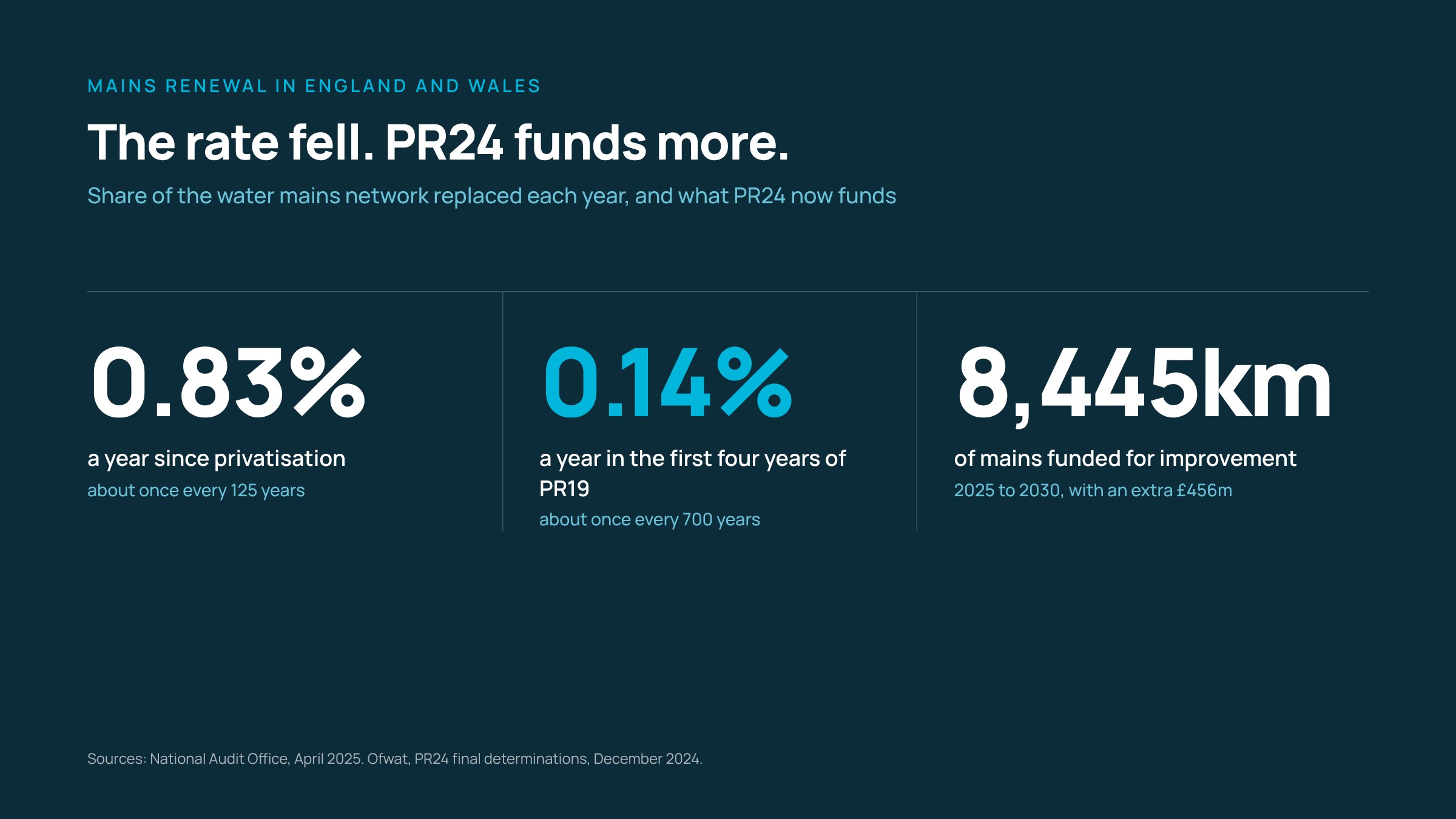
In April 2025 the National Audit Office found that water mains were replaced at 0.14% a year across the first four years of PR19. At that rate the whole network would take around 700 years to replace. The average since privatisation has been 0.83% a year, or once every 125 years.
PR24 set out to change that. Ofwat’s final determinations added £456 million to day-to-day allowances to increase the rate of mains replacement, with 8,445km of mains set to be improved between 2025 and 2030.
Funding answers how much. It does not answer where. A company renewing several hundred kilometres a year has to choose those kilometres from a network of tens of thousands, and then defend that choice to a regulator, a board and its customers. That choice is only as good as the evidence behind it.
A network measured by its failures
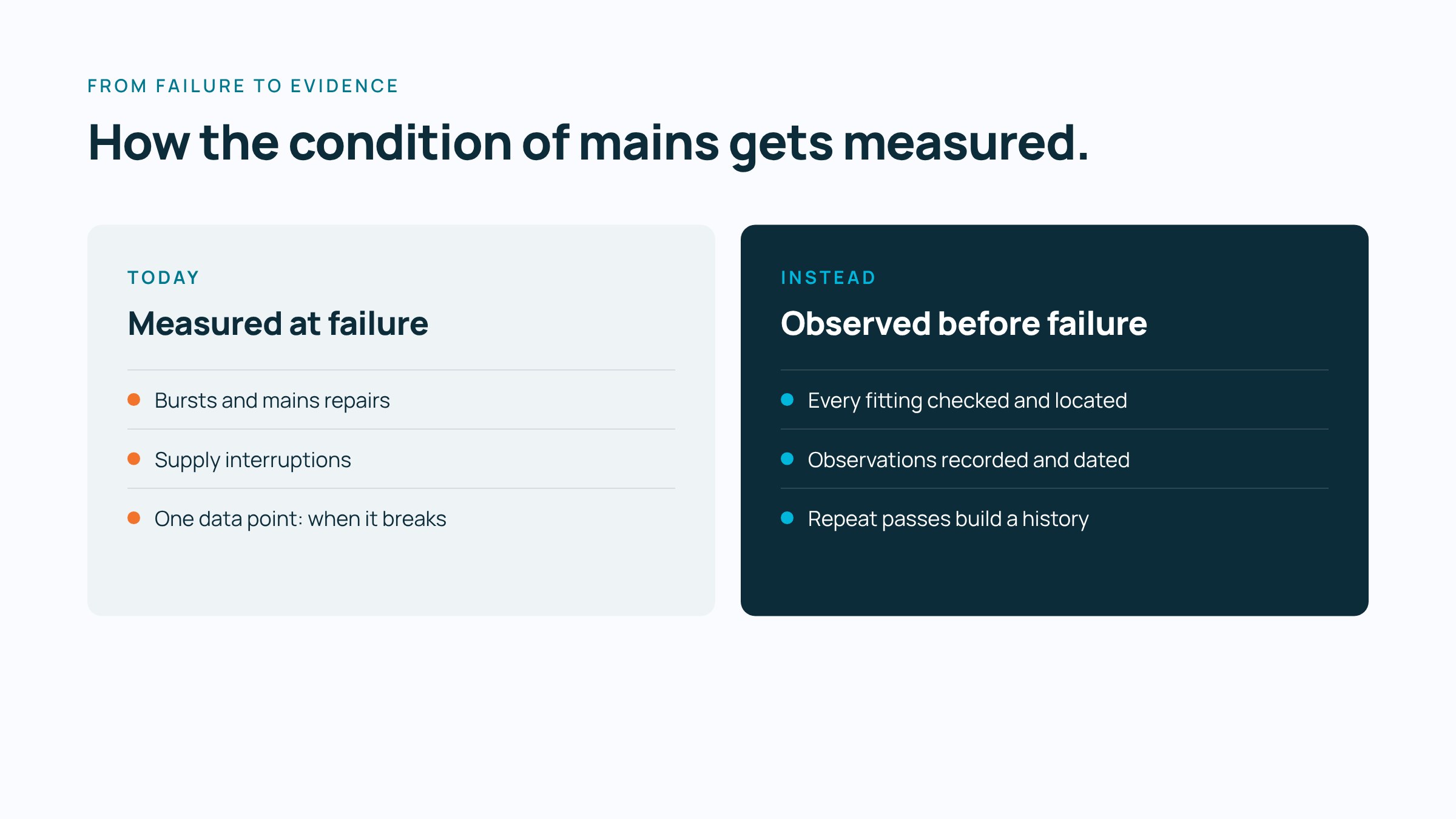
For most of the last 30 years, the sector has judged the health of its mains by what goes wrong: bursts, repairs and supply interruptions. In 2023 the National Infrastructure Commission told Ofwat that these are lagging indicators. They describe the condition of assets today, but their only data point is the point of failure, so they say little about how assets will behave in future.
The NAO reached a similar view two years later. It found that the regulators did not have a good understanding of the condition of infrastructure assets, because they had no set of metrics to assess it. Ofwat has since collected asset condition data on mains and a set of priority assets, and in May 2025 it acknowledged that this work does not yet cover all assets.
The result is a renewal programme that is funded but steered largely by history. A main that has burst three times is easy to prioritise. A main that is deteriorating quietly, with no failure on record, is invisible until it fails.
2026 changed the question
Three developments this year move the expectation from reacting to failure to evidencing condition before it.
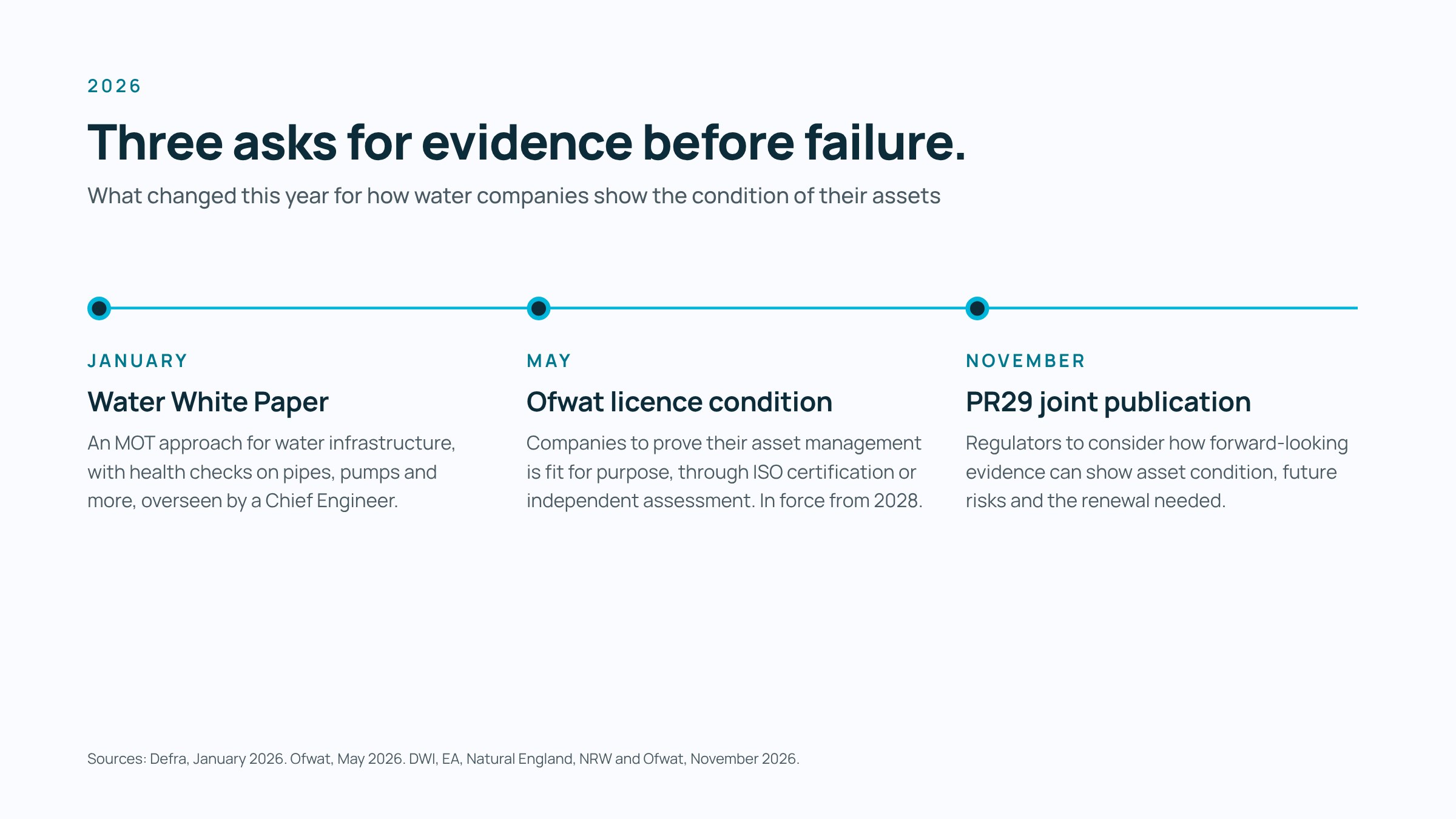
In January the government’s Water White Paper set out an MOT approach for water company infrastructure, requiring health checks on pipes, pumps and more, overseen by a Chief Engineer inside the new single regulator.
In May Ofwat proposed a new licence condition requiring every company to prove its asset management system is fit for purpose, across the full asset lifecycle, through ISO certification or an independent assessment. It is due to come into force in 2028. Ofwat is also running a sector-wide Asset Management Maturity Assessment this year, with early insights expected in early 2027.
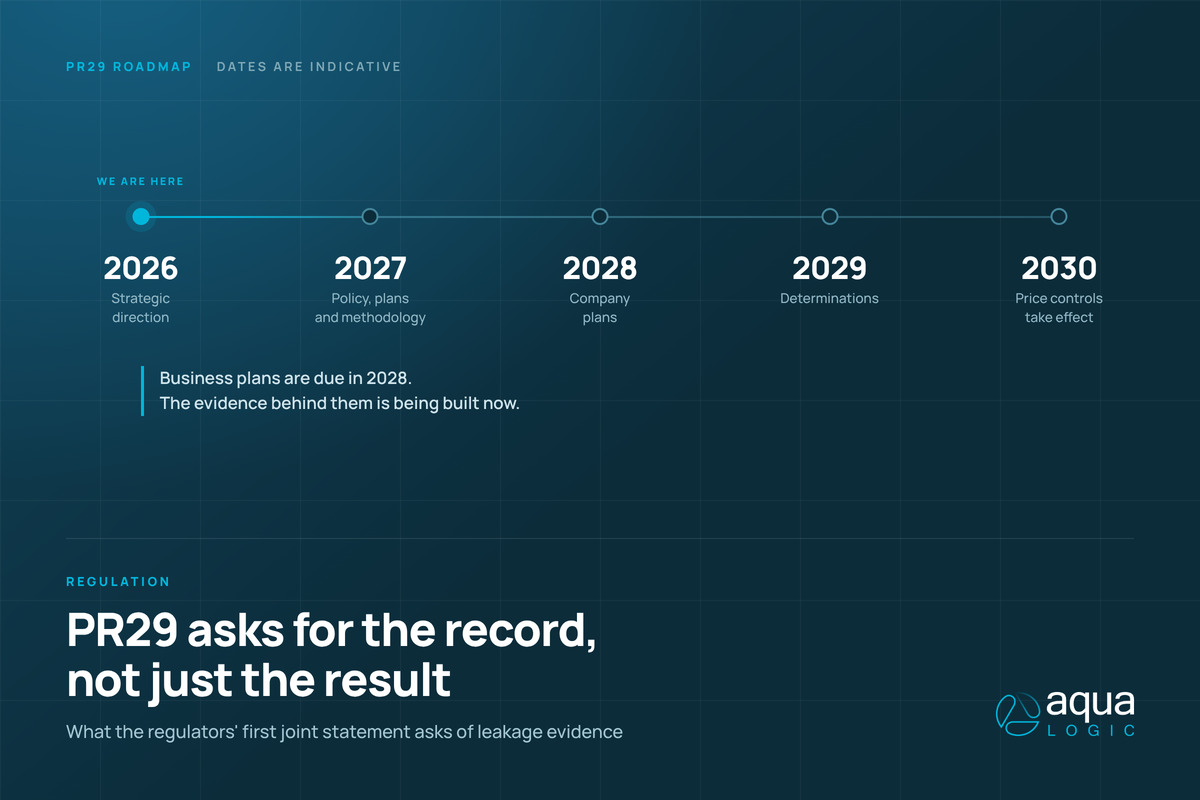
In November the regulators’ first joint publication on PR29 said they will consider how forward-looking evidence can provide greater transparency about asset condition, future risks and the maintenance and replacement needed. We looked at that in detail in PR29 asks for the record, not just the result.
Each asks a version of the same question: what do you know about the condition of your assets, and how do you know it?
Where the evidence can come from
Buried mains are hard to inspect. Digging them up to look is expensive and disruptive, and condition surveys of pipe walls cover a small share of the network at a time.
But the network is already being visited, every day, by leakage teams. A technician on a leak detection route checks valves, hydrants, meters and connections along kilometres of main. Most of those checks find no leak, and in most programmes that work leaves no record. The leaks get fixed and the rest of the information is lost.
It does not have to be. When every fitting checked is recorded against its location, with the time, the reading and what was observed, the same visit produces a record of the network as well as a list of leaks. That is how Aqualogic InSight works, and why we argued in What an auditable survey record is worth that the record is worth as much as the result.
It is worth being clear about what that evidence can and cannot do. A survey record describes what was inspected and observed. It does not establish the structural condition of every pipe, and it does not replace engineering assessment. What it adds is coverage: observed, dated evidence across the network, not just at the points that have already failed.
Evidence that can shape a renewal programme
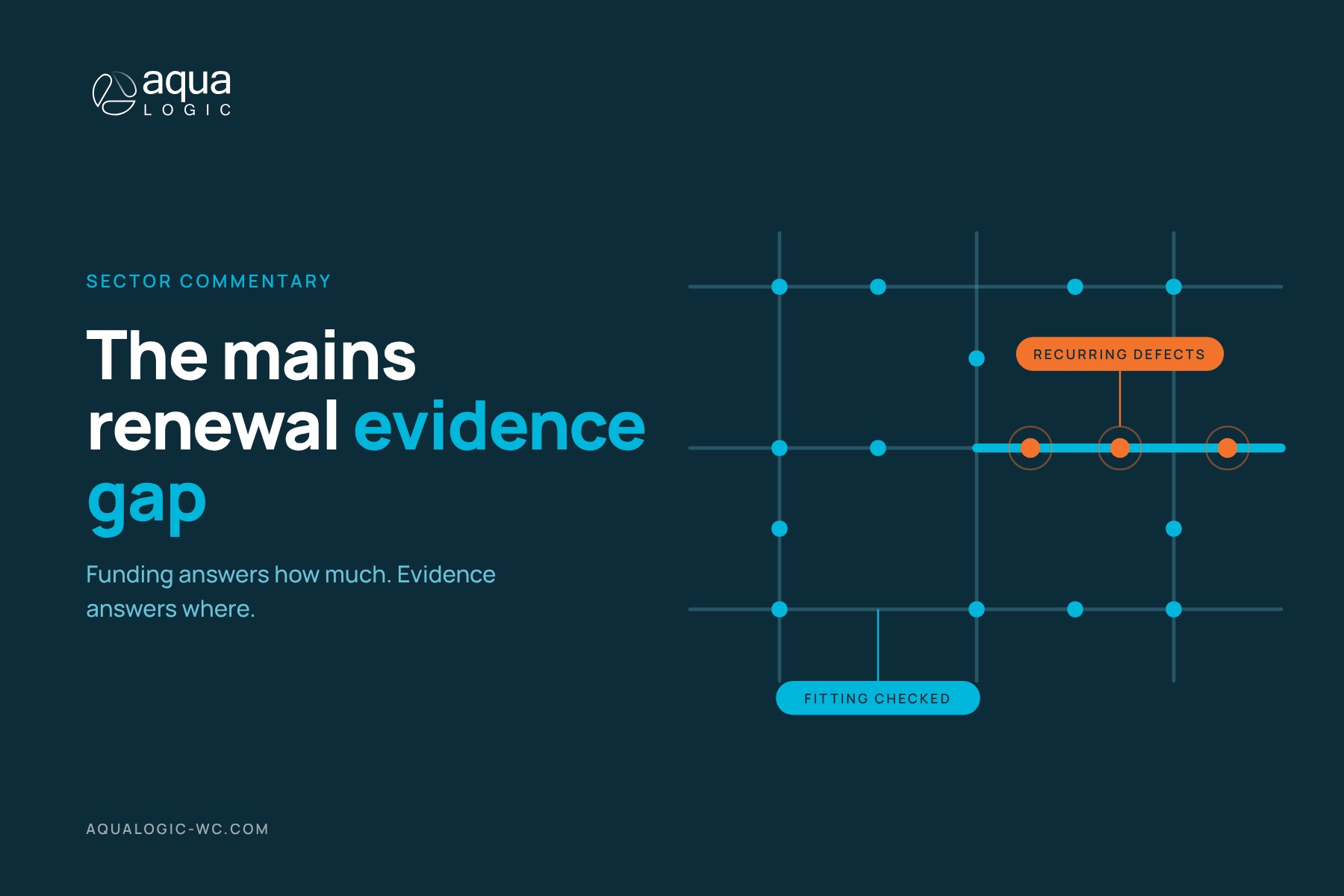
Over repeat passes, fitting-level records start to show patterns a burst log cannot. Clusters of leaks along a stretch of main. Recurring defects at the same fittings. Areas where access problems keep hiding part of the network from view. Each of these is a reason to look harder at a length of main before it fails, and a reason a renewal decision can point to when it is examined later.
Renewal is also only one of the levers. Some mains need replacing. Others can be kept in service for longer by reducing the stress on them. Pressure management and targeted network maintenance reduce leakage and asset stress on ageing pipes, and good evidence helps a company decide which response fits which length of main.
That is where joined-up work matters. When survey, pressure management and field delivery sit in one operation, the evidence runs in a single line: what was observed, what was done about it, and what changed afterwards. That is the kind of record an asset management system, an MOT-style inspection regime and a PR29 business plan can all draw on.
What to do before 2028
The licence condition is two years away and PR29 business plans are due in 2028. The evidence those plans rely on has to be gathered now, so it pays to look at what current leakage work leaves behind.
- Ask what your survey work records beyond the leaks it finds, and whether that record is tied to identified fittings and locations.
- Check whether you can show where a survey reached and where it did not, rather than assuming full coverage.
- Make sure survey records reach the people planning renewal and asset health, not just the leakage team.
- Plan for repeat passes, so single surveys build into a history of how each area is changing.
None of this replaces renewal. It makes renewal easier to target and easier to defend.
Where the figures come from
- National Audit Office, Regulating for investment and outcomes in the water sector, April 2025.
- Ofwat, PR24 final determinations, December 2024.
- National Infrastructure Commission, Letter to Ofwat on water company asset management, May 2023.
- Ofwat, Response to common issues on expenditure allowances, PR24 redeterminations, May 2025.
- Defra, Government unveils biggest overhaul to water in a generation, January 2026.
- Ofwat, Water companies face new obligations to prove their infrastructure is fit for purpose, May 2026.
- Drinking Water Inspectorate, Environment Agency, Natural England, Natural Resources Wales and Ofwat, Working together to deliver PR29, November 2026.
Aqualogic InSight
See what one visit would record on your network.
The InSight page carries a sample evidence record, so you can see the level of evidence a survey produces before commissioning one. Tell us about your network and the questions you need answered, and we will come back to you with what a survey would record.