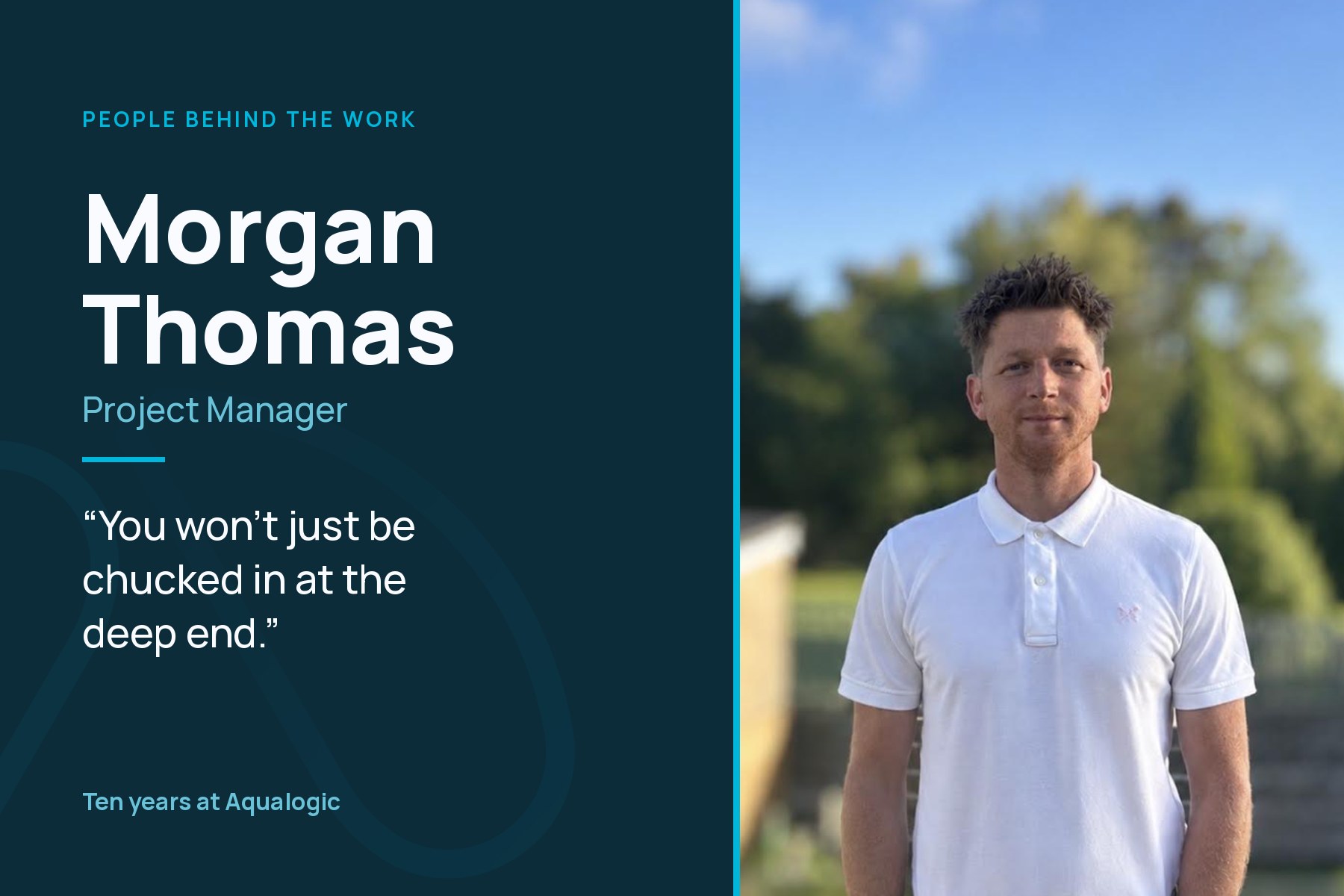
Morgan Thomas on ten years at Aqualogic
People behind the work
Morgan Thomas was twenty three when he joined Aqualogic in 2016, six months into a career in water and new to the clean water network. The Welsh operation he joined was a few people working out of one room.
Ten years on he is a project manager, running a team of eleven in the south west, and he has recently taken on a smart metering triage project across two further regions, supported by additional resource. He has worked through management qualifications alongside the job, and he signs off every new technician on his projects before they work on site alone.
We spoke to him about a decade in one company, why training gets offered before roles get advertised, and what he says to people who think they lack the background for this industry.
Coming home
Before Aqualogic, Morgan was working away. Manchester, Liverpool, Newcastle, a different city every other week, with little notice of where he would be sent next or how long he would be gone.
Then someone he knew got in touch about work in Wales.
“He offered me the opportunity to work from home, basically.”
That was the appeal, more or less in full. Not a title and not a step up, just the chance to do the same kind of work without living out of a hotel, alongside a few people he already knew.
Learning the network
Morgan came from the wastewater side, so the clean water network was new ground. The work he started on was non-household metering, going round commercial properties across Wales logging what was on the ground and what it was doing.
“I wasn’t sure if it was going to be really technical or hands on. It was a nice learning curve.”
That work grew. Pressure came next, and with it the pressure reducing valves and district meters that he now manages across a region. The technician job was where he learned the network he would go on to run, which is the part people tend to skip when they describe a career in this industry as starting at the bottom.
He was taken round and trained up by a colleague who had come across at the same time with five years in water behind him. When that colleague moved into the office, Morgan took over the pressure management work on site.
What struck him early was that the way the team worked did not look like the rest of the industry.
“We were trying to do new, innovative stuff. It just looked impressive.”
Jobs were tracked online rather than on paper. Vans were tracked. A job update went to the client the same day rather than as a photograph of somebody’s handwriting.
Growing with the company
Morgan’s progression has tracked the company’s. Each time Aqualogic took on something new there was a job that needed doing, and more often than not he was the one who did it.
“Through the first three years I started as a field tech, then I went up to senior field technician. By 2021 I was the senior engineer.”
That last step came with a change of contract. When Aqualogic took on work in the south west, Morgan took it on too, travelling down rather than relocating, and the senior engineer role came with the added responsibility.
The company changed around him at the same pace. One room became a unit the team quickly outgrew, then the office they work from now. Experienced people arrived from across the industry.
“You can see it with the personnel we’re bringing in. Everyone kind of knows the names now.”
He is careful not to make any of it sound like it was handed to him.
“It’s my hard work as well, to be honest. But it gives me a fair opportunity.”
Asked what comes next, he does not hesitate. More projects running at once first, then contract supervisor, working directly with clients on funding and costing.
What a good day looks like
The job now starts early, because his team does.
Jobs get planned in from around half five, since some of the team like to start at first light and others closer to eight. Then emails, and any customer complaints, which he wants dealt with before the day gets going. Then the previous day’s job list, checking that any devices swapped out have their serial numbers updated so the data reads correctly. Then a round of check-ins with the guys, usually on WhatsApp, making sure nothing has gone wrong with a van or a site.
Afternoons are for getting ahead of tomorrow. At the moment there is not much slack in the week.
“It’s quite busy with the warm weather we’ve had and demand increasing. We’ve been doing a lot of pressure reductions, so it’s just making sure we can save water anywhere else, even by a couple of metres.”
The complaints are not an irritation to him. They are how he sees the effect of the work.
“You see the impact it has. They come to me as the first point of call, so it’s building it all up, understanding why they’re complaining.”
One case was a block of flats. Water pressure falls the further up a building you go, so a reduction that is barely noticeable at ground level can be very noticeable on the top floor. Working out why a complaint has come in, and putting it right, is a large part of the job rather than an interruption to it.
A close group in a bigger company
Aqualogic has grown considerably in the last two years. Morgan’s clearest observation is that the thing he expected to change has not.
“We’re quite a close group, even though the company’s grown massively. Outside work we still meet up, have a drink or go out to eat.”
Ten years ago that meant a small group going out to France for Euro 2016 to watch Wales, which at the time was most of the office and site team. Now it means several colleagues living within twenty minutes of each other, close enough to meet up for a chat at short notice.
New arrivals get a managers’ meeting within their first month so everyone knows who is working on what, rather than finding out six months later that a colleague exists.
Some of the work involves nights away, and Morgan does not pretend otherwise.
“Sometimes it can be unsettling, spending your nights in hotels.”
Accommodation and the meal allowance are handled in advance, so nobody goes into the week unsure of the arrangements. Flexible scheduling is offered where the contract allows, so people can balance long distance travel, or commitments outside work such as study, alongside the job.
Training first, adverts second
Morgan has worked through a series of management and leadership qualifications alongside the job, with another still to come.
None of it was something he had to fight for. A senior colleague had taken the same route himself and wanted the team started on it, and going further was a conversation rather than a battle. Our HR team recently asked Morgan how it had been run, so the same support can be offered more widely.
He is measured about what the qualifications changed.
“You don’t realise you’re kind of doing it anyway. It just puts the names to it and shows how things actually work.”
The more important point is what the training is for.
“They’ve always liked to offer it in house before they actually put something out.”
Roles get filled from inside where they can be. Morgan’s own ten years are the evidence, and he is not the only one.
Why it matters
Pressure management is invisible work, which is rather the point. Managing pressure across a network reduces leakage, and it keeps ageing pipework in service for longer.
“The cost of having to replace all the pipelines would be a ridiculous amount, as opposed to where we can do our servicing on the PRVs. We can maintain that pipeline for another ten years.”
Ten more years out of existing infrastructure, at a fraction of the cost of replacing it, is the sort of result that never makes the news.
The technology has moved on considerably in his time. Devices that were once logged on paper, with nobody entirely sure where they all were, are now tracked through an app.
“You don’t think about it when you just turn the tap on. But that’s us doing our job well.”
“You don’t need a skill to enter the industry”
Ask Morgan what kind of person does well at Aqualogic and he does not describe a CV.
“It’s not always the person who’s seen, not the loudest, but you can see them ticking over in the background. Happy to be in work, eager to learn.”
Curiosity counts for more than experience, and he sees it in his own team.
“Some of them text me stuff they’ve found online, because they’re trying to build their development in the background.”
Then the line that matters most for anyone reading this and wondering whether to apply.
“You don’t need a skill to enter the industry. It’s such a large industry and you’re always learning on the job. The opportunities are there to progress.”
He would rather people did not rule themselves out on the strength of one advert.
“There are different entry points, so don’t think you’re not suited to that one. There’ll be plenty of other roles that could be adaptable too.”
The technology is usually what worries people most, and there is a structure behind it. Inductions have been extended so people leave with their logins working and their questions answered. New technicians then spend around three weeks shadowing on site, and Morgan goes out himself for the harder jobs, runs a site audit and signs them off when they are ready.
“You won’t just be chucked in at the deep end. We make sure everyone’s skilled up before they carry out any work on their own.”
It is worth pausing on who is saying that. The man taken round by a colleague in 2016 is now the one deciding when somebody else is ready.
Ten years, one company
Ten years is a long time to stay anywhere. Morgan puts it down to growth and development, and he means his own as much as the company’s. He arrived as a technician logging meters at commercial properties and now runs a team of eleven, with a smart metering project across two further regions on top, and contract management the step he is working towards next.
The openness he describes as the best thing about his team is the mechanism behind most of that. It is why he has his qualifications, because asking was enough to start the conversation. It is why roles get discussed internally before they are advertised. It is why people on his team send him things they have found rather than waiting to be shown. And it is why, after a great deal of growth, he still expects to be able to raise something with anyone and get an answer.
Asked to sum up what Aqualogic does, he keeps it broad: helping water companies reduce waste, improve performance and strengthen long-term resilience, through network support, leak detection, water efficiency and smart metering. Asked why someone should come and work here, though, he points outwards rather than inwards, to how far the company has come and the name it has built across the industry.
“The reputation is speaking for itself.”
And if he could go back to that room in 2016 and tell himself something, he would not change the advice at all.
“Keep doing what you’ve been doing.”
We are hiring across our field, technical and client services teams. Most of our people did not arrive with a background in water. See our current vacancies.
Aqualogic, a Sustec company